What gives way first
Anywhere else, choosing a blind is a decision about light. On this stretch of the Atlantic it is mostly a decision about durability — because the wind, the salt and the sand will find the weakest component of whatever you install, and they will find it in a predictable order. This guide is that order, written down.
This guide is also a PDF you can download and read offline (14 pages).
The village, honestly described
Kommetjie takes its name from the little rock basin at its edge, and everything about its weather follows from where that basin sits: on the ocean side of the Peninsula, low, flat and open, with the Slangkop light standing on the point and Long Beach running north into the dune belt.
Three consequences for a window.
The sun sets into the sea, every single evening of the year. There is no ridge, no headland and no neighbour tall enough to interrupt it. Whatever faces west here takes the full descent, and in midsummer that descent is long.
Nothing breaks the wind. The summer south-easter arrives across low ground with very little to slow it, and the winter fronts come in off open Atlantic. A house here has no natural shelter to borrow.
The air carries sand as well as salt. That is the difference between this village and a rocky cove. Sand is abrasive, it accumulates, and it finds tracks, channels and bearings. It is also the failure mode nobody warns a new owner about.
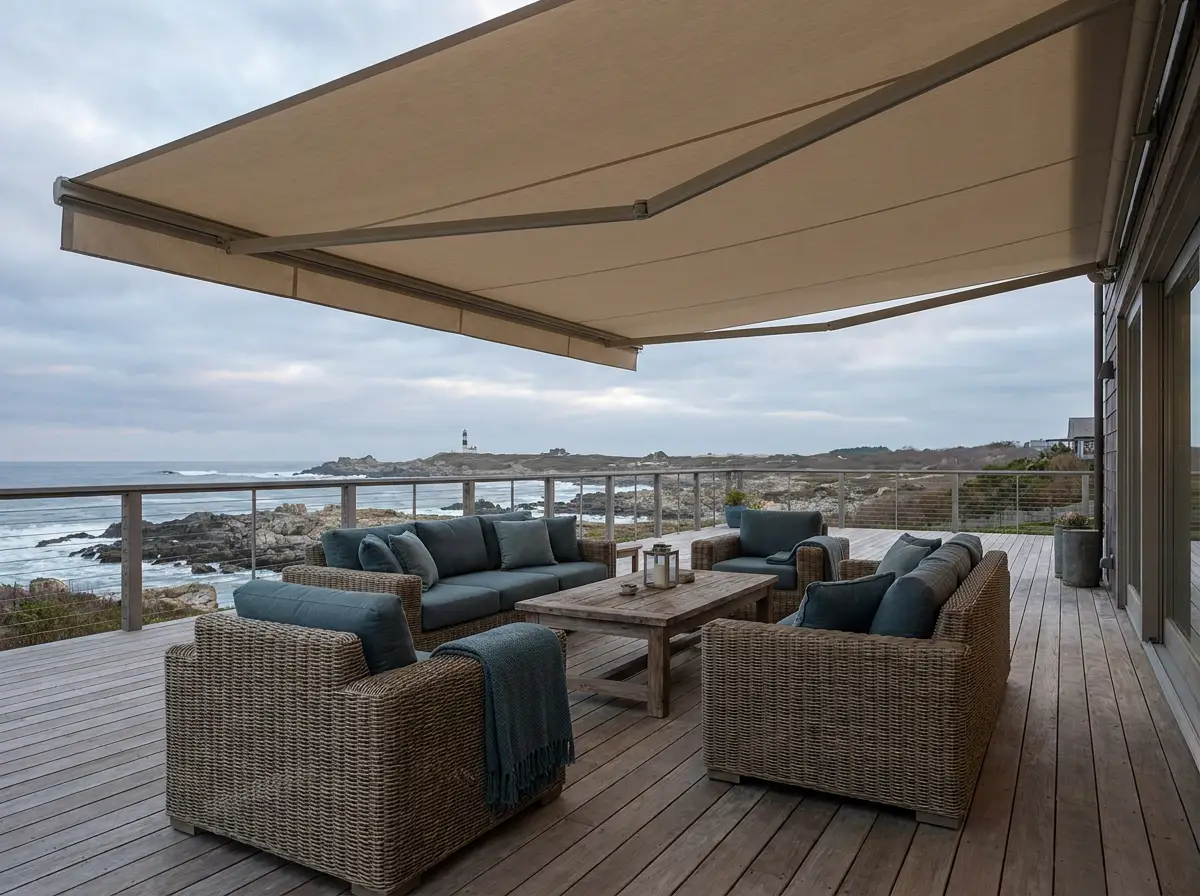
Slangkop's cast-iron tower — the tallest of its kind on the South African coast, first lit in 1919 — is a fair emblem for the specification argument here. It is a piece of ironwork that has stood in this air for a century because it was built for it and it has been maintained ever since. Neither half of that sentence is optional.
The failure chain, in order
When an installation on this coast goes wrong, it almost never goes wrong at the part people worried about while choosing. Here is the real running order, from first to last.
-
Fails first
The fixing, and what it went into
An outdoor shading product is only ever as good as the six screws holding it up, and on this coast those screws live in salt fog. Two things go wrong. Ordinary stainless pits and weeps rust stains down a wall; and a stainless screw driven straight into an aluminium bracket puts two dissimilar metals in contact in a salt-laden environment, which is exactly the recipe for galvanic corrosion at the joint.
The fix is unglamorous: marine-grade stainless fixings, isolation where the metals meet, and — just as important — an honest look at the substrate. A single-skin dune cottage wall and a modern reinforced lintel do not hold the same load.
-
Fails second
The bracket, the headbox and every cut edge
Powder coating protects aluminium beautifully until somebody drills through it on site. The bare edge of a hole, or a channel cut to length on the driveway, is where white bloom starts, and from there it works sideways under the coating.
Manufacturers quote salt-spray performance from laboratory testing, usually the neutral salt spray method set out in ISO 9227. It is a genuinely useful comparison between products — and it is a chamber, not a beach. Ask what the finish is; do not treat a test-hour figure as a lifespan.
-
Fails third
The moving parts
Bearings, chains, ladder tapes, guide channels and folding arms all have one thing in common: a small gap that sand can enter. Grit in a channel is why a blind starts binding two seasons in, and grit in a bearing is why a smooth tube starts to grind.
Design decides how bad this gets. Channels that shed rather than collect, and heads that can be flushed with fresh water, will outlive a cleverer system with nowhere for sand to go.
-
Fails fourth
The fabric
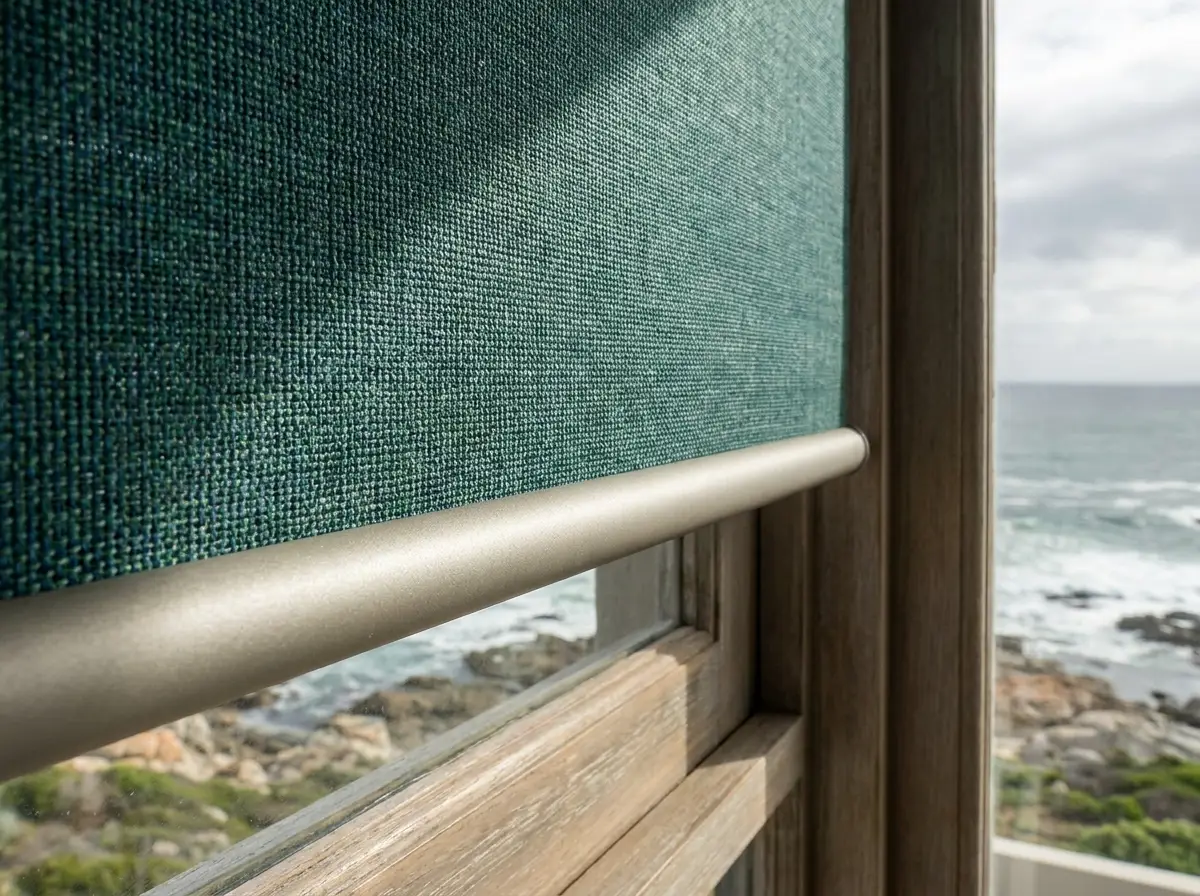
Outdoors, ultraviolet does the slow damage and salt does the fast damage — crystals form in the weave, then abrade the coating from inside every time the wind moves the cloth. South African summer ultraviolet regularly reaches the top of the international scale, and this coastline gets it with reflection off water and pale sand on top.
For anything exposed, that means solution-dyed acrylic or a PVC-coated glass-fibre mesh, where the colour is part of the fibre rather than printed on it. Indoors it matters much less, and you can choose on looks with a clear conscience.
-
Fails last, but hurts most
The motor and its sensor
A properly specified external motor will outlast most of what surrounds it. What kills them is water finding the cable entry, and installations where an indoor-rated unit was quietly used in an outdoor position because it was cheaper.
The sensor is the part worth arguing about. A wind sensor that retracts an awning without being asked is the single most valuable component on an exposed property, because the storm that damages your installation will arrive on a weekday while you are in town.
The wind number nobody quotes
If you take one technical thing away from this guide, make it this one, because it is where most disappointment on this coast begins.
External blinds and awnings are classified for wind resistance under EN 13561, the European standard the industry works to. It sets four classes, and each one corresponds to a step on the Beaufort scale:
| Class | Beaufort equivalent | Roughly |
|---|---|---|
| Class 0 | below Beaufort 4 | a light breeze; effectively unrated |
| Class 1 | Beaufort 4 | a moderate breeze, around 20–28 km/h |
| Class 2 | Beaufort 5 | a fresh breeze, around 29–38 km/h |
| Class 3 | Beaufort 6 | a strong breeze, around 39–49 km/h — the highest class in the standard |
Now the part that gets glossed over. The class describes the wind in which the product may be left extended. It is not a survival rating. Class 3, the top of the scale, is roughly a strong breeze — a wind that a Kommetjie summer afternoon exceeds without anybody remarking on it.
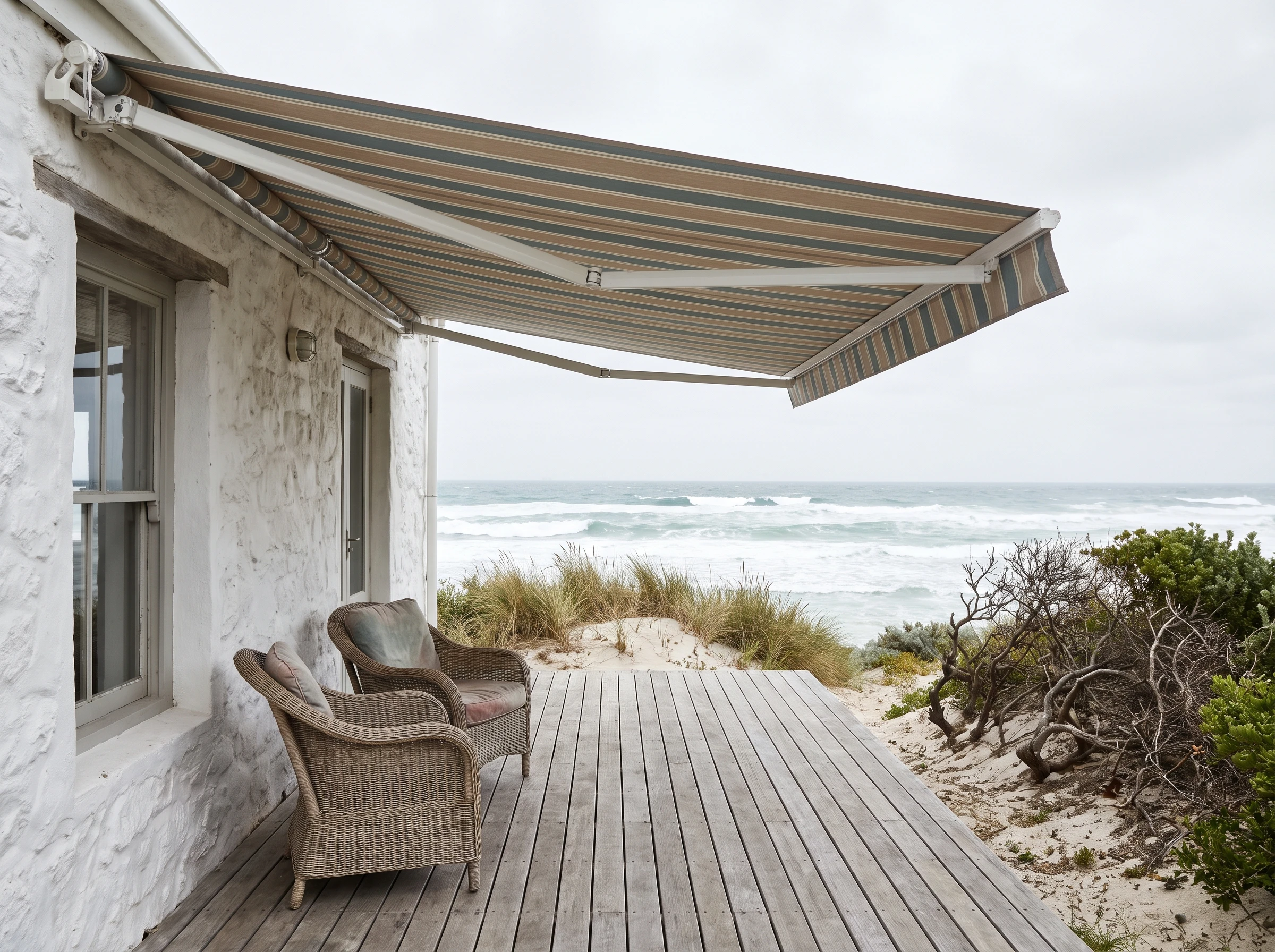
No folding-arm awning made anywhere is rated to be left out in a Peninsula south-easter. That is not a fault in the product and it is not a reason to go without one. It means the automation is the specification: a wind sensor set sensibly, and a habit of retracting before you leave, is what makes an awning a twenty-year purchase rather than a two-year one.
Products that run in fixed side channels — the zip-track family — are a different proposition, because the fabric is captured on all four sides rather than hanging from two arms. That is precisely why they are the outdoor product we push hardest in this village, and why an open-sided deck screen is a poor idea a hundred metres from Long Beach.
Where external shading actually pays for itself
Everything above is about survival. This section is about performance, and on a west-facing Atlantic house the two point in the same direction.
A blind hanging on the inside of a window can only intercept sunlight after the glass has already admitted it. The fabric absorbs the energy and then sits in your room radiating it back — you have traded glare for warmth, which on a February evening is not much of a trade. Move the same interception outside the glass and the heat is stopped in open air, where it convects away before the pane is involved at all.
That is why external shading is the premium tier here and why we lead with it on any seaward elevation, in this order:
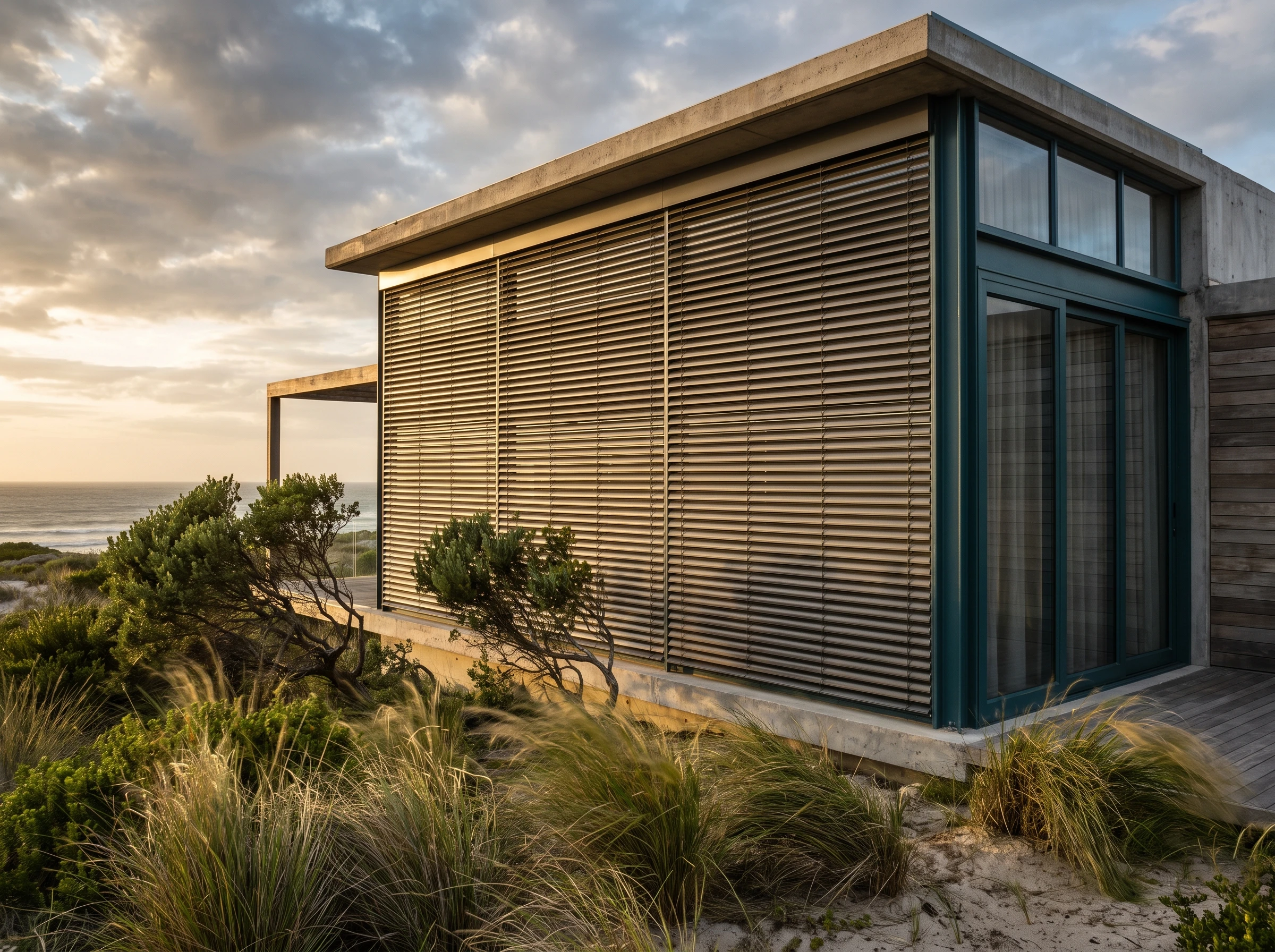
- External venetian blinds. The most complete answer for a west wall. Aluminium slats outside the glazing, angled through the afternoon, so the heat goes but the horizon does not.
- Roller shutters. Rigid slats rolling down outside the opening for total control of sun, heat and glare when a room needs shutting down completely. A shading product here — nothing on this page is a security claim.
- Zip screens. Mesh held in zipped side channels, which is what makes an outdoor room usable on a village where the wind is the default condition rather than the exception.
Inside the glass, the west-facing recommendation is a fine sunscreen weave rather than a heavy blockout. Blockout on a sea view is a strange purchase: it solves the glare by removing the reason you bought the house. Save it for the bedrooms.
Dune-house problems nobody warns you about
Sand gets into the bottom of everything
Bottom rails, sill channels and door tracks collect it, and it works as a grinding paste. On any product that runs in a track, ask whether the track can be cleared without dismantling the blind — the answer decides how the thing ages.
The glass hazes before you notice
Salt film on the outside of a window scatters light, which makes a room feel glarier than the sun alone can account for. Before spending on shading, wash the outside of the worst window and look again. It is free and it occasionally changes the answer.
Low eaves flatter the north and abandon the west
Much of the older village stock is single storey with a modest overhang. In midsummer the noon sun here stands close to overhead, so even a shallow eave shades a north window well. Late in the day the sun is nearly level with the window, and that same eave contributes essentially nothing. Two elevations, two completely different answers, on the same little house.
Outdoor rooms are wind rooms
A braai stoep or a covered deck in this village fails on wind long before it fails on sun. Enclosing it on the exposed sides gains you far more usable evenings than shading it from above ever will.

Five years, told straight
Any supplier who tells you their hardware needs nothing on this coast is either inexperienced or hoping you will not check. Here is what genuine care looks like, and it is not much.
- After a big blow: hose the salt and sand off external hardware with fresh water. This one habit does more than any specification decision on the list.
- Twice a year: clear guide channels and check that nothing has worked loose. Ten minutes with a hose and a cloth.
- Annually: look at every drilled fixing on an external unit for rust weeping, and at the fabric edges for fraying. Both are cheap to fix early and expensive to ignore.
- When something binds: stop forcing it. On this coast a stiff blind is almost always sand, and forcing a sanded track is how a repair becomes a replacement.
We would rather quote you a smaller job with the right hardware than a bigger one that looks impressive in year one and embarrasses everybody in year four. If a particular opening does not need us, we will say so at the measure.
Before a measure
Five minutes of preparation, no expertise required.
- How exposed is the house, really? Dune-front, second row, or tucked behind others. It changes the specification more than the room does.
- Which way does the problem window face? Your phone's compass is accurate enough.
- Is the complaint wind, glare, heat or privacy? They have four different answers and people frequently buy for the wrong one.
- What is the wall made of? If you know, say so. If you do not, say that instead of guessing — we will check on site.
- Is anything on the property already failing? An old awning or a seized track tells us more about your microclimate than any description can.
Specify it for the weather, once.
Free in-home measure, fabric and hardware samples in hand, and a written per-window quote before anything is ordered.
Start with whatever you know
Three windows or thirty, certain or just curious — send it through and one of our expert consultants will contact you shortly to arrange your free in-home measure.
Checkable sources
Everything stated as fact above comes from one of these. Where we were not sure, we left the claim out rather than round it up.
- EN 13561 — the European standard for external blinds and awnings, which defines wind resistance classes 0 to 3 against the Beaufort scale. Class 3, the highest, corresponds to Beaufort 6.
- The Beaufort scale wind speeds quoted are the internationally published ranges; Beaufort 6 is a strong breeze of roughly 39 to 49 km/h.
- ISO 9227 defines the neutral salt spray test used by manufacturers to compare coating and hardware performance in a laboratory chamber.
- Seasonal wind patterns for the Cape Peninsula — the summer south-easter and the winter north-westerly fronts — and ultraviolet index forecasts are published by the South African Weather Service.
- Sun altitudes and sunset bearings referred to above can be reproduced for Kommetjie's coordinates and any date on the NOAA solar position calculator. Sunrise and sunset tables for South Africa are published by the South African Astronomical Observatory.
- Slangkop Lighthouse on the point at Kommetjie is a cast-iron tower first lit in 1919 and is the tallest cast-iron lighthouse tower on the South African coast; it is a working aid to navigation operated by the national ports authority and open to visitors.
The failure order, the maintenance advice and the product opinions above are our own, offered free and without obligation. They are general guidance, not an engineering assessment of any particular building.