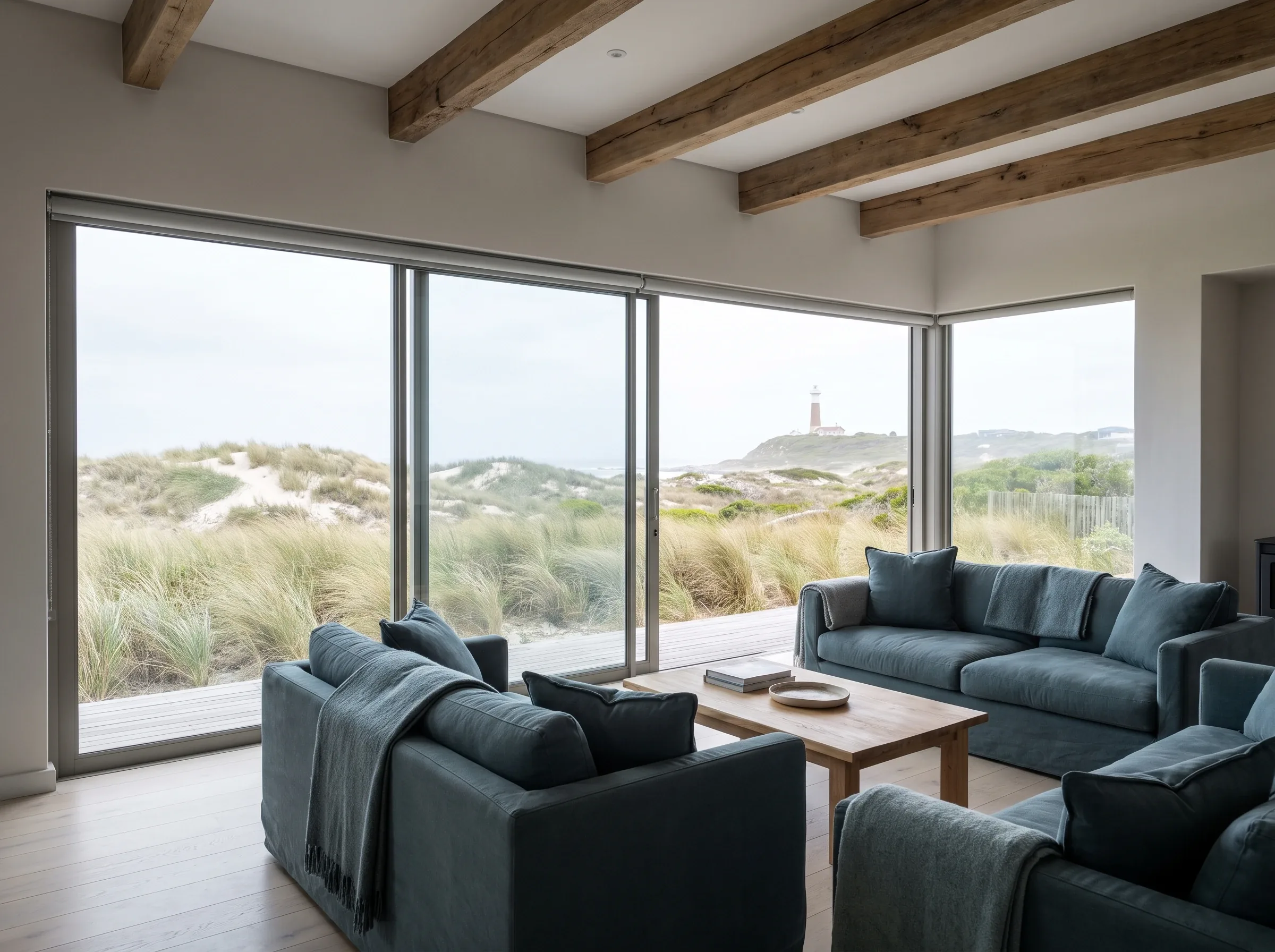
Roller blinds, cut for the light at the Kom
One tube, one panel of fabric, and most of a house’s daily shading handled. The whole decision comes down to which weave goes in which room — and that’s exactly what the free measure is for.
Pick the weave by the job the room does
Mechanically, a roller blind is the simplest thing we sell: a flat panel of fabric on an aluminium tube, driven by chain, spring or motor, cut to your window’s exact size. Everything that matters happens in the fabric choice.
The three fabrics
Blockout stops light completely and adds a real layer of insulation — the default for bedrooms, and worth considering for any room that bakes through a summer afternoon or leaks warmth on a howling July night.
Sunscreen is a fine mesh, usually 3–5% open. By day it takes the sting and the UV out of light off the water while the dunes stay visible through the weave. One honest caveat: after dark the effect flips, and a lit room reads from outside. Living rooms love it; bedrooms want blockout too.
Light-filtering sits in the middle — a soft glow, full privacy, no view. Bathrooms, studies, street-facing rooms.
Want two of those in one window? A double roller hangs blockout and sunscreen on a single bracket, so a bedroom can keep its morning view and still go properly dark at night.
What we do differently this close to the sea
Kommetjie’s spray reaches every street in the village, so the tube, brackets and chain get specified in aluminium and coated finishes as standard — not as a coastal surcharge. Chain loops are anchored taut to the wall with tensioners on every install: safer for children, and quieter when the south-easter finds an open window. And because most big glass here angles south-west over the dunes, the daily fight is long, steady afternoon glare off the water — the exact fight sunscreen mesh was designed to win. Round on the False Bay side the weave is the same but the openings are not. A Victorian bay window in St James takes its own small blind pane by pane, and a cottage window in Kalk Bay gets measured on its own, since the original openings there seldom line up with a catalogue width.
What it comes to, in rands
Rollers are sold by the metre squared of blind, fitted. Chain-driven, a metre squared costs R1,000 to R1,600 — a plain blockout near the first figure, a good mesh or a twin bracket holding two weaves near the second. On a tube motor, a metre squared costs R2,500 to R3,800, motor, control and the day’s pairing-up counted in.
That per-metre figure breaks down on tiny openings: a bathroom window takes the same tube, the same coated brackets and the same climb as a lounge slider, so the small ones carry a floor price. Nor is a spread a quotation — every opening is costed on its own after the free measure and written down before a metre of cloth is cut.
The three things people ask about rollers
One bedroom, two needs — dark for sleeping, view for waking. Which fabric wins?
Neither has to. A double roller carries blockout and sunscreen on one bracket, so you drop the mesh for a soft, view-keeping morning and the blockout when it’s time to sleep. Where a bracket can’t take a double, two slim single rollers do the same job — the consultant will tell you which your reveal allows.
Our lounge glass is one wide sliding wall. Can a single roller span it?
Depends on the width and the fabric — past a certain span, one blind either splits into two with a neat join line, or the wall gets two or three motorised blinds linked to run as one. Both look intentional when they’re measured properly. The measure settles which route your wall takes, with real numbers rather than a guess here.
Do rollers survive this village’s salt, or will the hardware pit and stick?
Inside the house, salt arrives slowly but it does arrive — Kommetjie sits low enough that no street escapes it. That’s why tubes, brackets and chains go in as aluminium and coated components by default on our installs. It’s the difference between a blind that still runs smoothly in ten years and one that grinds in three.
Bring the samples to your windows.
Hold the actual weaves up against your actual view — the measure is free, and the quote lands in writing, window by window.
Rollers on your mind? Say so here.
Mention the rooms and roughly how many windows — one of our expert consultants will contact you shortly to arrange your free in-home measure.